
How Water Clarity Impacts Fly Selection on the Bow River


Choosing the right fly can sometimes feel like the most complicated part of fly fishing.
Open a well-stocked fly box and suddenly you are staring at dozens of colours, sizes, shapes, and patterns—all supposedly capable of catching the same trout.
While hatch activity, water temperature, and fish behaviour all play a role in fly selection, there is another factor anglers often overlook: water clarity.
The amount of visibility in the river affects how easily trout can find your fly, how closely they can inspect it, and how comfortable they feel feeding. On the Bow River, clarity can change quickly after rainfall, runoff, or changes in river flow.
Learning how to adjust your fly selection based on water clarity can make a noticeable difference during a day of Bow River fly fishing.
The key is not simply choosing a brighter fly when the water gets dirty. You need to consider visibility, contrast, profile, movement, depth, and presentation.
Here is how to adjust your approach.
Why Water Clarity Matters to Trout
Trout rely heavily on sight when feeding, but that does not mean they stop eating when the water becomes stained.
In fact, slightly dirty water can sometimes produce excellent fishing because trout may feel less exposed and become more willing to move for food. They may continue feeding in shallower water, along banks, and near protected edges.
What changes is how the fish locate and evaluate their food.
In clear water, a trout may see your fly from farther away, but it also has more time to inspect the pattern, leader, and presentation.
In stained water, the fish may have a smaller visual window. Your fly needs to be easier to locate, and trout may react more strongly to contrast, movement, vibration, and water displacement.
These conditions create very different fly-selection situations.
Fly Selection in Clear Water
Clear water often looks inviting to anglers. You can see the river bottom, identify underwater structure, and occasionally spot individual trout.
Unfortunately, those trout may also be able to see you.
When the Bow River is clear, fish can become more cautious, especially in slower water. Heavy footsteps, repeated casts, shadows, and unnatural fly movement can quickly put them on alert.
Clear water is usually the time to lean toward realistic, subdued colours that resemble the food already present in the river.
Good choices may include:
Olive
Brown
Tan
Black
Grey
Cream
Patterns such as Pheasant Tails, Hare’s Ears, Zebra Midges, and smaller stonefly nymphs can all be effective depending on the insects available.
You do not necessarily need a fly that perfectly duplicates every leg and wing of a natural insect. However, its general size, shape, and colour should make sense for the conditions.
Reduce the Fly Size
When trout have a clear view of your fly, an oversized pattern may look suspicious—particularly in slower currents.
Downsizing your nymph, dry fly, or streamer can help create a more natural presentation. A smaller fly can also be useful when fish have experienced heavy angling pressure or are feeding selectively.
This does not mean you should automatically use the smallest fly in your box. Start by matching the approximate size of the available food and adjust from there.
Limit Unnecessary Flash
A little flash can attract attention, but too much may make a pattern look unnatural in bright, clear conditions.
Copper, subtle pearlescent materials, or a lightly reflective bead may be enough to imitate the shine of an insect’s body or the scales of a small baitfish.
Save heavily reflective patterns for situations where visibility is limited or trout are responding aggressively.
Focus on Presentation
Clear water often makes presentation more important than the exact fly pattern.
A perfectly selected fly that drags unnaturally through the current will usually be less effective than a general pattern presented with a clean, natural drift.
Before replacing your fly, check your depth, drift, leader position, and approach.
Quite often, the fly is not the problem. It simply is not reaching the fish or moving naturally.
Fly Selection on the Bow River in Lightly Stained Water
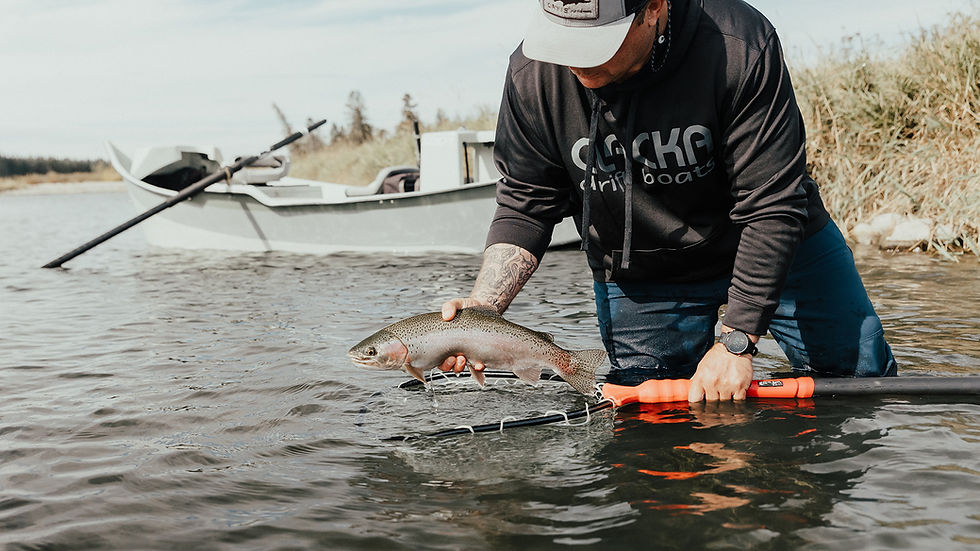
Many anglers see a slightly cloudy river and assume the fishing will be difficult. However, lightly stained water can create some of the most productive conditions for fly fishing in Calgary.
The trout can still see well enough to feed, but the reduced visibility may make them feel safer. It can also make minor imperfections in your presentation less noticeable.
This is a good time to add more attraction without completely abandoning natural patterns.
Add Contrast
In stained water, contrast helps your fly stand out against the surrounding water.
Dark colours such as black, dark brown, and purple often create a strong silhouette.
Bright colours such as chartreuse, orange, or pink can also help, particularly when used as a small hotspot rather than throughout the entire fly.
A natural-coloured nymph with a coloured collar, bead, or tail can offer the best of both worlds: a believable profile with enough attraction to help trout locate it.
Increase the Profile Slightly
Moving up one fly size can make your pattern easier to notice.
You do not need to jump from a small nymph to the largest fly in your box. A modest increase in size may be enough to improve visibility while still resembling something the trout regularly eat.
Patterns with rubber legs, soft hackle, marabou, or other mobile materials can also create movement without requiring an excessively large fly.
Consider Movement
When visibility decreases, movement becomes especially valuable.
Rubber legs pulse in the current. Soft hackles breathe as they drift or swing. Marabou moves even during a slow retrieve.
These materials can help a fly appear alive and draw attention from nearby trout.
This is one reason Woolly Buggers, stonefly patterns, and leech imitations can perform well when the river carries some colour.
Fly Selection in Murky Water
When visibility drops significantly, subtle presentation becomes less important than helping the trout locate your fly.
This is the time to emphasize silhouette, movement, profile, and water displacement.
Choose a Strong Silhouette
Dark patterns often remain highly visible underwater because they create contrast, even when anglers assume a bright colour would be easier to see.
Black, dark olive, brown, and purple are all useful options. Larger stonefly nymphs, leeches, and dark streamers can create a clear outline in murky water.
Bright flies can still work, particularly worm patterns or flies with fluorescent hotspots, but brightness alone is not always the answer.
Contrast is often more important than colour.
Use Larger Patterns
A slightly larger fly gives trout a bigger target.
Murky conditions can be a good time to fish:
Larger stonefly nymphs
San Juan Worms
Leeches
Woolly Buggers
Sculpin patterns
Streamers with marabou or rabbit strips
Larger flies also move more water, which may help nearby trout detect them.
Streamer fishing can be especially productive when rising or stained water creates opportunities for predatory trout to target displaced, disoriented, or vulnerable baitfish.
Add Weight
A highly visible fly will not help if it is drifting several feet above the fish.
Higher or dirtier water may require additional weight, a heavier bead, or a different leader setup to reach the productive depth.
Make controlled adjustments rather than adding excessive weight immediately. The goal is to keep the fly close to the trout without constantly catching the bottom.
Fish the Edges
During high or dirty water, do not automatically focus on the middle of the river.
Trout may hold along banks, inside seams, behind structure, and in softer water where they can conserve energy.
Fishing close to the bank can be especially important when the main current is heavy.
Choose a fly that can be presented accurately in these smaller feeding lanes.
A Simple Water-Clarity Guide
Water visibility cannot be reduced to one exact formula, but the following guide provides a practical starting point.
Very Clear Water
Use smaller, natural-looking flies with subtle flash. Fish carefully, lengthen your leader when appropriate, and prioritize a natural, drag-free presentation.
Lightly Stained Water
Use natural patterns with slightly more contrast, movement, or a small hotspot. Consider increasing your fly size modestly.
Murky Water
Choose larger patterns with strong silhouettes, movement, and enough weight to reach the fish. Dark colours, worm patterns, stoneflies, leeches, and streamers are all worth trying.
Extremely Dirty Water
Concentrate on softer water, banks, seams, and any pockets with improved visibility. Use flies that are easy to locate, but recognize when conditions have become unsafe or impractical to fish.
Do Not Change Flies Too Quickly
One of the most common mistakes in fly fishing is changing patterns before determining whether the current fly has been presented properly.
Before reaching into your fly box, ask yourself:
Is the fly reaching the correct depth?
Is it drifting naturally?
Am I fishing water that is likely to hold trout?
Have I covered the area thoroughly?
Would adjusting the weight, indicator position, or retrieve make a bigger difference than changing the fly?
Fly selection matters, but depth and presentation often matter more.
A basic nymph fished properly will usually outperform the “perfect” pattern drifting several feet above the trout.
Build a Fly Box for Changing Bow River Conditions
A useful Bow River fly box should give you options for different levels of water clarity without containing hundreds of nearly identical patterns.
Carry a selection of:
Small, natural nymphs for clear water
Medium-sized attractor nymphs with subtle hotspots
Stonefly patterns in several sizes and weights
Worm patterns in natural and brighter colours
Dark leeches and Woolly Buggers
Streamers with different profiles and amounts of flash
Dry flies covering several sizes and silhouettes
The goal is not to carry every fly ever tied. It is to have enough variation in size, colour, profile, movement, and weight to adapt when river conditions change.
Let the River Guide Your Decision
There is no single best fly for the Bow River.
The best choice depends on what the water is telling you that day. Look at the clarity. Observe whether insects are active. Pay attention to where the trout are holding and how confidently they are feeding.
In clear water, become more subtle.
When the river carries some colour, increase contrast and movement.
When visibility becomes limited, give the trout a larger, more noticeable target and place it where the fish can find it.
Understanding how water clarity affects fly selection will not eliminate every slow day, but it will help you make more deliberate decisions—and spend less time randomly digging through your fly box.
Looking to learn more about reading the Bow River, adjusting your setup, and choosing flies for the day’s conditions? Join Bow River Bank Robbers for a guided Bow River fly fishing experience and put these strategies into practice on the water.


Comments