
Urban vs Remote Bow River Fishing: What Changes When You Leave Calgary Behind?


There aren’t many places where you can catch trout within sight of downtown buildings in the morning and spend the afternoon floating through open prairie with barely a hint of the city around you.
That’s one of the coolest things about Bow River fly fishing.
The Bow doesn’t suddenly become a completely different river when it leaves Calgary, but the experience of fishing it definitely changes. Access changes. The way you cover water changes.
The amount of activity around you changes. And depending on the stretch, your approach to finding and presenting flies to trout may change too.
Alberta considers the Bow downstream of Calgary a world-renowned sport fishery for its rainbow and brown trout, but some anglers are surprised to learn just how productive the river can be inside the city as well.
So, is urban fly fishing in Calgary better? Or should you head for the lower Bow and get away from it all?
Like most things in fly fishing, the answer is: it depends.
Urban Bow River Fishing: World-Class Trout in the Middle of Calgary
One of the Bow River’s biggest advantages is accessibility.
You don’t need a full day, a drift boat, or a carefully planned expedition every time you want to fish. There are multiple river access points throughout Calgary, and the City specifically encourages people using the river to choose designated access locations to help reduce impacts on sensitive shoreline and spawning habitat.
For local anglers, that makes urban Calgary fly fishing hard to beat.
Have two hours after work? Go fish.
Want to sneak out early on a Saturday morning before the rest of your day starts? Go fish.
But easy access doesn’t necessarily mean easy fishing.
Urban Trout See a Lot
Trout living within Calgary aren't exactly tucked away in some forgotten mountain stream.
Popular sections can see anglers, walkers, cyclists, rafters, dogs, construction, traffic and just about everything else that comes with a river running through a major city.
That doesn’t mean trout stop feeding.
It does mean that good presentation matters.
A fish sitting on a heavily fished seam may have seen plenty of indicators, nymph rigs, streamers and dry flies before yours arrives. Getting the depth right, reducing drag and presenting the fly naturally can make the difference between getting an eat and watching your rig drift through untouched.
Urban fishing can make you a better angler for exactly that reason.
You learn quickly that casting farther isn't always the answer.
Sometimes it's one step closer.
A slightly longer leader.
A cleaner mend.
A smaller fly.
Or simply approaching the water more carefully.
Urban Fishing Rewards Anglers Who Learn to Read Structure
Inside Calgary, it's tempting to think in terms of access points.
“I'll fish this park.”
“I'll try below this bridge.”
“I'll walk this pathway.”
But trout aren't organizing themselves according to city landmarks.
They're responding to current, depth, structure, food and protection.
That means successful Bow River fishing still comes down to finding things like:
Current seams
Drop-offs and depth changes
Soft water beside faster current
Inside bends
Bank structure
Riffles transitioning into deeper runs
Feeding lanes created by changing current
The more you stop looking at the city around you and start looking at what the water is doing, the more the urban Bow begins to make sense.
What Changes on the Lower Bow?
Head downstream and things start feeling different.
The skyline disappears.
The pathways disappear.
Buildings give way to open country, long banks and that big Alberta sky.
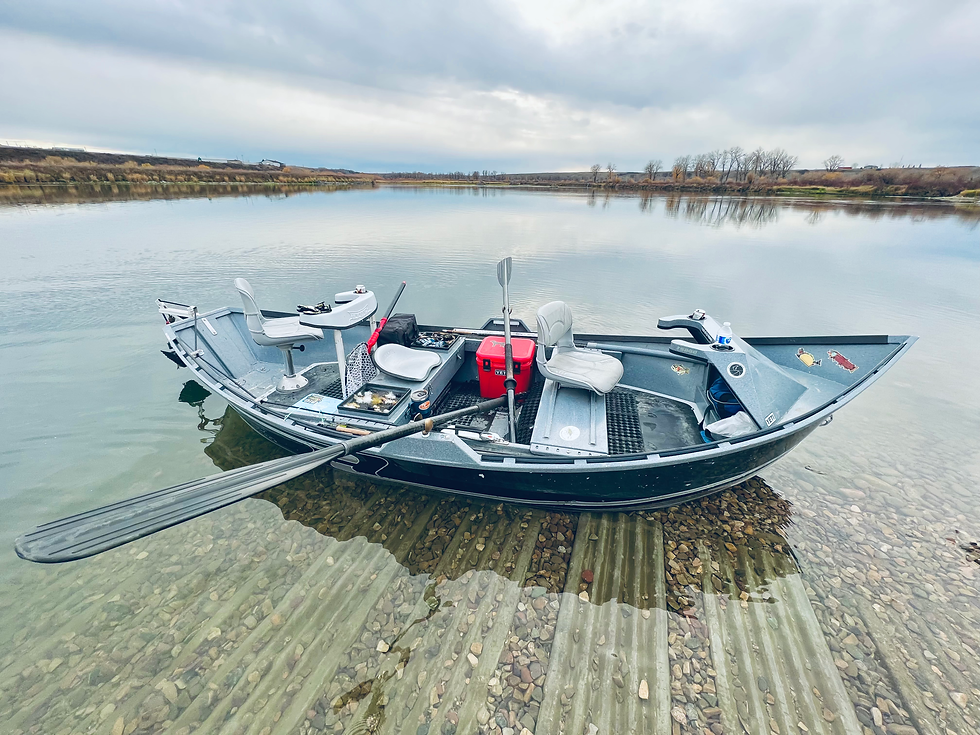
This is the part of the river many people picture when they think about a full-day Bow River fly fishing trip, and it's where we spend much of our time at Bow River Bank Robbers. Our guided trips focus on exploring the lower reaches of the Bow from a drift boat, giving anglers the ability to cover significantly more water during a day.
And that's probably the biggest difference between urban and remote fishing:
Mobility.
When you're wading inside Calgary, you might carefully work several hundred metres of productive water.
From a boat on the lower Bow, you're continuously moving through new water.
New banks. New seams. New riffles. New buckets. New opportunities.
That changes the way you fish.
Remote Doesn't Mean the Trout Are Easy
There's a common assumption that leaving Calgary automatically means finding untouched trout that will eat whatever you throw at them.
We wish.
They're still Bow River trout.
They can still humble you.
A remote-looking bank may have been fished by multiple boats that week. A textbook run might look perfect and produce absolutely nothing. Meanwhile, a piece of water you almost overlook can suddenly produce the best fish of the day.
The biggest advantage isn't necessarily that remote trout are less educated.
It's that you can keep moving.
If one piece of water isn't producing, a float allows you to change the equation.
You can switch tactics.
Change depth.
Move from nymphs to streamers.
Watch for rising fish.
Target banks.
Fish riffles.
Then keep going until you find the type of water the trout are using that day.
That ability to search is one of the reasons float fishing and guided fly fishing in Calgary can be such an effective way to learn the Bow.

Urban vs Remote Bow River Fishing at a Glance
Urban Bow River
Easy access for shorter sessions
Excellent for wade fishing
More people and city activity
Great opportunity to learn specific runs
Fish may experience regular angling pressure
Easy to revisit and study the same water
Ideal for before-work
Calgary skyline and pathways
Lower Bow River
Better suited to longer fishing days
Drift boats make covering water efficient
Quieter, more immersive surroundings
Constant access to changing water types
Pressure varies depending on the stretch
Great for searching for active fish
Ideal for half-day and full-day adventures
Open prairie and lower Bow scenery
When talking about urban vs remote bow river fly fishing, neither one is automatically better.
They're simply different ways to experience the same incredible river.
The Fishing Pace Is Completely Different
Urban fishing tends to slow you down.
You walk.
You watch.
You pick apart a seam.
You change flies.
You move upstream 20 metres and try again.
And there's something incredibly valuable about that process.
When you fish the same urban stretch repeatedly, you begin seeing details that weren't obvious the first time. You learn where fish move when flows change. You notice how a run fishes differently at 8 a.m. versus 8 p.m. You recognize where trout tend to hold during certain hatches.
Remote float fishing teaches a different skill.
Instead of memorizing one piece of river, you're learning to quickly identify productive water.
You might only have seconds to decide where that next cast should land.
Is the fish tight against the bank?
On the seam?
At the head of the run?
Behind that piece of structure?
The river keeps moving, so your decision-making has to move with it.
Both styles make you better at fishing the Bow River, just in different ways.
Your Tactics May Change Too
There isn't one setup exclusively for Calgary and another for the lower Bow.
Conditions dictate tactics far more than postal codes.
The Bow can provide opportunities for nymph fishing, streamer fishing and dry fly fishing depending on season, water conditions and insect activity. That's why being adaptable is such a huge part of success here.
That said, the way you deploy those tactics can change.
When wading urban water, you can methodically work a productive seam multiple times. You have time to adjust indicator depth, change weight, shorten the cast or switch flies before moving.
On a float, efficiency becomes more important.
You need to get the fly where it belongs quickly.
Streamer fishing becomes a great way to actively cover banks and structure. Nymphing allows you to work productive runs while moving through them. And when the right dry fly opportunity shows up, being ready can turn an ordinary stretch of river into the part of the day everyone remembers.
Which Style Is Better for Beginners?
Both can be excellent.
Urban fishing offers beginners a low-commitment way to start learning the Bow. You can practice casting, reading water, mending and managing line without committing to an entire day.
The challenge is figuring out where to start.
The Bow is big water, and big water can be intimidating.
A beginner can stand beside an incredible run and have absolutely no idea which ten feet actually matter.
A guided float helps solve that problem because you're constantly seeing different examples of trout habitat while someone explains why you're casting where you're casting.
Over the course of a day, those repetitions start adding up.
Eventually you begin spotting those same features yourself.
And that's when the Bow starts feeling a little less mysterious.
Conservation Matters Wherever You Fish
Whether there's a Calgary bike path behind you or nothing but open prairie along the bank, you're fishing the same incredibly valuable trout fishery.
For 2026, Alberta's regulations list the Bow River from the Banff National Park boundary downstream to Bassano Dam, including the reservoir, as open year-round with a bait ban and zero-trout harvest limit. Always check the current Alberta Sportfishing Regulations before heading out, because regulations can change.
Handle trout carefully.
Keep fish wet whenever possible.
Don't drag them onto the bank for photos.
Pay attention to water temperatures during hot weather.
Respect spawning areas and sensitive riverbanks.
And leave the river in better shape than you found it.
The Bow gives Calgary something very few major cities have. Taking care of it means anglers years from now can experience exactly what we're lucky enough to have today.
So, Urban or Remote Bow River Fishing?
Why choose?
One of the best things about fly fishing in Calgary is that you can experience both.
Urban fishing gives you accessibility, quick sessions and the opportunity to study individual pieces of water until you really understand them.
The lower Bow gives you space, movement, incredible scenery and the chance to spend an entire day exploring constantly changing trout water.
Each teaches you something different.
Each can produce incredible fish.
And each reminds you why the Bow River has built the reputation it has.
Sometimes the best way to learn this river isn't deciding which version is better.
It's fishing both.
Experience the Lower Bow River With Bow River Bank Robbers
If you've spent time fishing the Bow inside Calgary and you're ready to see how the river changes farther downstream, come explore it with us.
Bow River Bank Robbers offers half-day, full-day, shared boat and overnight fly fishing experiences designed for everyone from first-time fly anglers to experienced fishermen looking to better understand the river.
We'll cover the water, adjust to what the river gives us and probably talk about trout more than any reasonable person should.
That's kind of the point.
Ready to experience a different side of Bow River fly fishing? Book your next trip with Bow River Bank Robbers and come see what happens when the city disappears behind you.


Comments